
Native Girls Code – Learning technology skills together
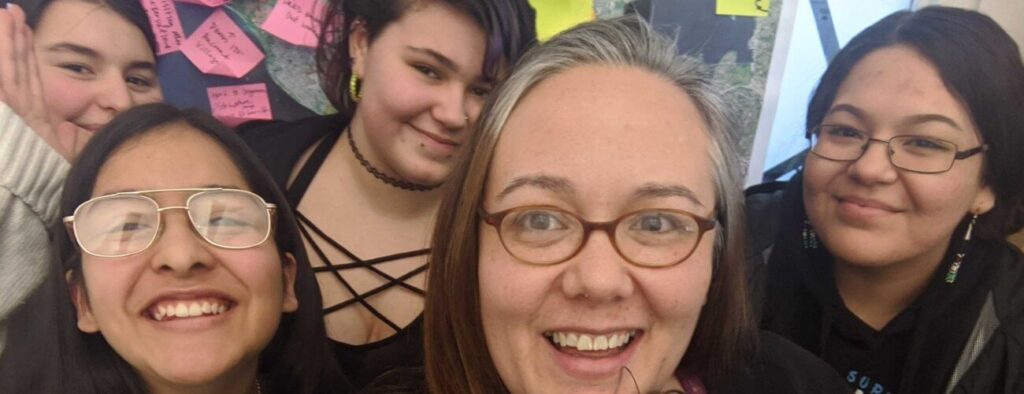
For seven years, Native Girls Code participants met, building relationships with one another while they learned and explored technology—and life—together. “Native women in tech are rare. To see a program specifically aimed at Native young women for coding was really special, because it hadn’t existed before,” says Shawn Peterson (Nuu-chah-nulth), Na’ah Illahee Fund’s community partnerships manager.
Native Girls Code, a program developed by Na’ah Illahee, began in 2015 with Shawn Peterson as program coordinator and Elizabeth LaPensée (Anishinaabe, Métis, and Irish), Rose Bigheart O’Leary (Osage, Quapaw, Cherokee, Mi’kmaq), and Carisa Chang (Chinook) as facilitators over the course of the program. Rather than focusing on completing training modules, they made their program project based. Along the way, the middle school and high school students had opportunities to participate in University of Washington research projects, as well as work with Tech Tales to redesign a coding instruction manual for BIPOC youth.
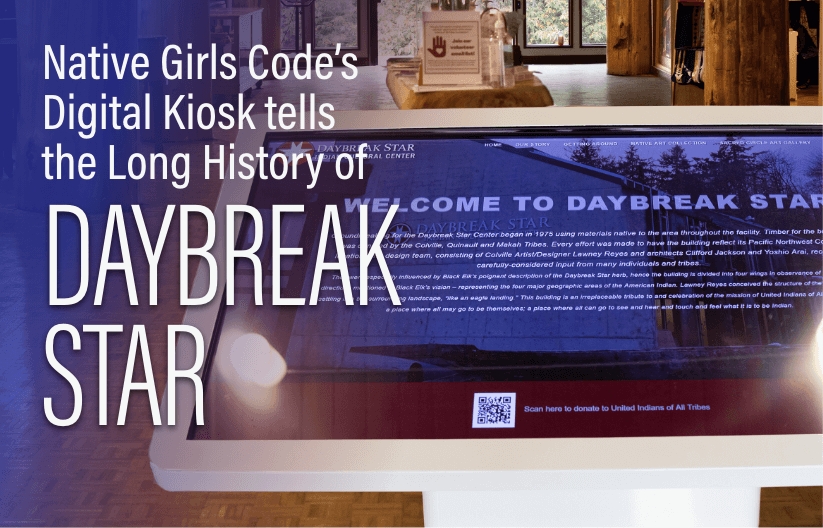
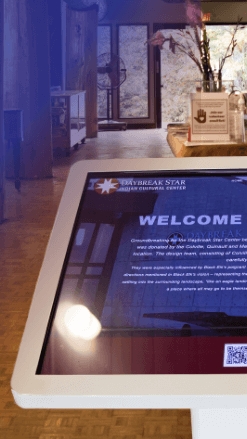
The kiosk project for Daybreak Star Indian Cultural Center
Seattle Parks and Recreation heard about Native Girls Code and approached Peterson about designing digital kiosks that would tell the story and history of Daybreak Star Indian Cultural Center, which is located within the boundaries of Discovery Park. Peterson applied for and received a grant from Seattle Foundation’s Neighbor to Neighbor (N2N) program, and planning for the kiosk began.
“I was excited about the opportunity,” Peterson says, “because it would give the girls in my program a chance to practice reciprocity. A lot of the girls had been with me for a long time and had really developed a lot of skills, and giving back to the community was important to them.”
The kiosk also presented another opportunity – bringing increased visibility to the long history of Daybreak Star. Placed inside the main entrance, the kiosk would greet visitors right as they entered the building, making the story easily accessible. “The goal of the project was twofold—reciprocity and to help with the invisibility our community faces,” Peterson says.
“We started with just having conversations with the group,” she says. “I would ask them, ’When you go there, and enter the building, what are the things you’d want to know about? What do you want others to know about the place?’”
At the time, United Indians of All Tribes Foundation was in the process of assembling information about the Fort Lawton takeover in 1970, led by the gang of four–Roberto Maestas, Bernie Whitebear, Larry Gossett and Bob Santos–and many other Native community members that led to the creation of Daybreak Star. Because of this, Peterson and her group had access to large amounts of archival materials that were not yet digitized. They worked closely with United Indians of All Tribes Foundation to gather the historical information they needed and for final approval of the content.
“The history was actually the easy part,” she says. Once they had the content approved, they got to work on the coding for the kiosk’s digital interface with much-appreciated support from Elizabeth Starks (Zuni/Navajo), an artist and programmer connected to the University of Washington as an application developer. “It was a lot of work and a heavy lift,” Peterson says.
Recognizing Systemic Barriers that Perpetuate Invisibility
About this time, a potential problem arose when someone from Seattle Parks and Recreation pressed for the creation of two kiosks, one for Daybreak Star and one for the Discovery Park Environmental Learning & Visitor Center. The kiosk for the park would match the other Seattle Parks and Recreation kiosks already on site. The grant money for the project wasn’t enough to cover two kiosks, so it was suggested that the first kiosk would just go in the park.
“We said absolutely not,” Peterson recalls. “First, you’d be taking the funds and the kiosk, without considering what kind of position that puts a community like Daybreak Star in. They don’t have access to unrestricted funds to build another kiosk and hire a bunch of people to develop, create and maintain it.”
“Then next, taking the girls’ hard work and placing it in kiosks that blend in with the other park kiosks is a form of erasure and assimilation. Both things are just a continuation of oppression and systemic invisibility, an example of the systemic barriers our community faces all too often, “Peterson says.
“Ultimately, we were able to do what we said we were going to do.” With the grant money, and through the hard work of our young women, Native Girls Code brought the kiosk to Daybreak Star Cultural Center. The group hoped to launch the kiosk at the 50th Anniversary celebration of the Fort Lawton takeover, but that was in 2020 and COVID-19 had other plans. With everything in limbo, Na’ah Illahee Fund made the decision to end the Native Girls Code program. Peterson continues to keep in touch with several of the eight girls who participated, as well as their families.
The kiosk was finally unveiled in 2021, and Peterson says from the comments she’s heard, the kiosk is viewed as “a great resource that was desperately needed.” Located in a high-traffic area on the same level as the gift shop at Daybreak Star, the digital kiosk received a lot of activity and interaction at the 33rd Annual Seafair Powwow. The participants in the project are grateful to the staff of United Indians of All Tribes for all their support over the years that it took to complete this project.
Daybreak Star’s Digital Kiosk Project has a Future to Grow
Peterson says there are discussions about what to do with the kiosk project next. Ideas include adding signage with QR codes on the grounds surrounding Daybreak Star that could be synced to a future public-facing website so that even if the center was closed, visitors could still access the information. Information could be included about the many native plants that have been restored to the grounds. Visitors might be able to see the Lushootseed word for what they’re looking at and hear it spoken
“There’s still so much more historical content that we can share with the public, like these really cool old maps that show waterways and how it used to look pre-contact. In the future we could add these so you can understand where you are in relation to that context and what the land that you are standing on appeared like back then,” Peterson says. “So, we believe the kiosk project has a future to grow. This is just a starting point.”