
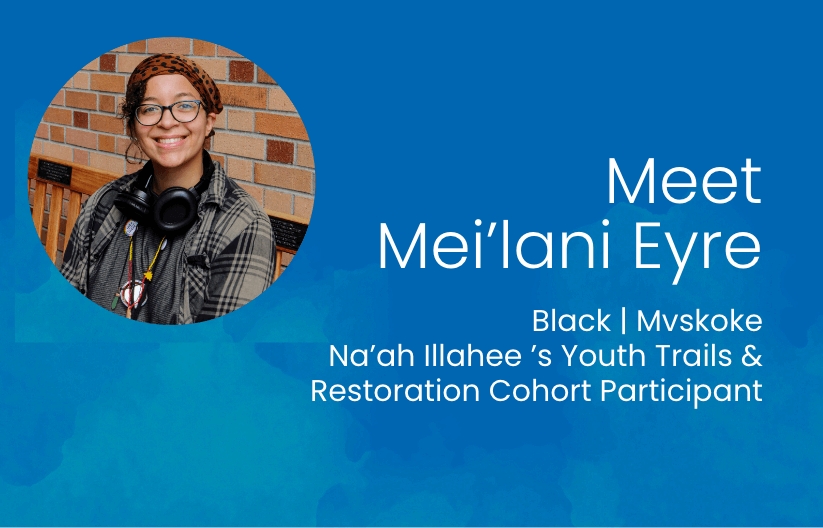
Meet Mei’lani Eyre (they/them), a graduate student working toward a degree in library and information sciences at the University of Washington. For the past two years, Mei’lani has participated in Na’ah Illahee Fund’s Youth Trails and Restoration Cohort at Discovery Park in Seattle.
The restoration work is part of Na’ah Illahee Fund’s Indigenous Food Sovereignty program, designed to re-establish thriving systems that preserve traditional knowledge, connect communities, and decrease dependence on unhealthy industrial food systems.
The cohort youth gather and work on the 20 acres adjacent to the Daybreak Star Indian Cultural Center, where they learn about aligning the use of the park with Indigenous cultural values and practices and work to decolonize the landscape
The program is the result of a partnership between Na’ah Illahee Fund, Daybreak Star, and Seattle Parks and Recreation. In the past year, cohort youth removed non-native plant species from around Daybreak Star including Himalayan blackberry, English ivy, black iris, and buttercup. Those invasive plants were replaced with 5,000 native plants, including 1,000 camas bulbs. With the help of an employee from Seattle Parks and Recreation, the recent cohort also learned how to build a trail.
This fall, they are expecting another 4,000 native plants to be delivered and planted.
For Mei’lani, the experience as part of a cohort at Discovery Park coincided with a personal journey of discovery.
“Around the time I had started my reconnection journey, with multiple lines down my family,” Mei’lani said. “And a lot of what was intersecting across all of those family lines—I’m Black and Mvskoke—was a connection to nature, a connection to plants. …I also really like learning about plants and who they are.”
“You learn about the ways in which plants grow, you learn about how to really appreciate the lives of these plants, the things they have contributed just for us to get something as simple as a couple of berries, and knowing the ways in which these plants have relationships with each other in this ecosystem, how they’re talking to each other, how the trees are talking to them, how they’re using mycelium. So, you’re learning a lot of science, you’re learning a lot of history, you’re learning a lot of traditional knowledge.”
“And for me personally, it’s been a really valuable way to reconnect not even just with my indigeneity, but with my blackness, with my ancestors that had these beautiful farms. They had these gorgeous gardens, so they were so connected to the land, and I can feel them smiling with me when I’m working.”
Mei’lani grew up in various places around Puget Sound, including Federal Way, Kirkland, and Redmond, and doesn’t remember a lot of time spent in the natural world. They moved to Seattle in 2020. Previous to participating in the cohort, Mei’lani had never spent time at Discovery Park and had only heard about Daybreak Star.
It became a multi-generational experience. At different times, both their mother and grandmother joined them on the cohort’s community planting days.
“And so that’s three generations coming together to work with the land to get those teachings, to try to reconnect. And I’m even more grateful for Na’ah Illahee Fund and this cohort and Daybreak Star, just for giving us that opportunity to collectively work toward reconnection.”
Mei’lani’s education at the University of Washington has included several classes about Indigenous systems of knowledge. Their interest in librarianship centers on special collections for both Native American and African American materials, which can include everything from plants and seeds to oral histories to unique documents, and more. “As a librarian that is Black and Mvskoke, I want to make sure our people don’t forget who they are. And if I’m the keeper of those records, I’m going to help them remember and make sure that connection stays unsevered.
“Daybreak Star is a living archive,” Mei’lani said. “It’s a place with so much history, and it’s a history that we’re repeating orally. Every time we get together, we’re talking about the fish wars, we’re talking about Bernie Whitebear, we’re talking about Fort Lawton, and how the takeover happened, we’re talking about Alcatraz.
“And then we’re talking about how we are a part of that history, how we’re literally planting the seeds that will grow into something new, to help change into a different era of Daybreak Star’s history, of that land’s history. And it’s the stories, it’s the actions, it’s the ceremonies we’ve had that really all come together to become that living archive. And that’s the legacy we get to leave behind.”